
Key Takeaways
As AI agents take on more of the actual work, good judgment becomes what sets people apart. The advantage no longer comes from working faster, but from deciding what to aim for, checking the quality, and directing people and agents toward the result.
What holds AI back is the organization, not the people. In most companies employees are already ahead of the systems around them. The real limit is culture, incentives, and metrics that still reward the old way of working, not a shortage of talent.
Getting value from AI is a leadership job, not a technology purchase. The payoff comes only when strategy, managers, and incentives reward people for changing how they work. Buying more tools without changing how the work gets done achieves little.
The most valuable employees are redefining their roles, not just working faster. They treat what AI produces as a first draft, stay responsible for the thinking, and shift from creating the work themselves to checking it, improving it, and standing behind it.
Lasting advantage comes from learning faster than competitors, not from adopting AI first. The companies pulling ahead learn from their own work and keep people in control of reviewing it as they use more agents. That edge builds over time and is hard for others to copy.
Introduction
The opportunity for human potential at work has never been greater. People are using AI and agents to expand both what they can do and who gets to do it, and the trend is only accelerating: 88% of organizations now use AI, up from 78% a year earlier and 55% the year before that.¹ AI agents are not simply the next software upgrade. As AI moves from handling isolated tasks to working across complete workflows, the structure of the enterprise itself is changing, organized increasingly across people, agents, and the systems that connect them. As agents take on more of the execution,² people gain more agency, meaning more room to direct the work, make the decisions, and own the outcomes. The deeper change is where human value now sits: as execution becomes cheap to scale, the premium moves to judgment, orchestration, and learning. For every firm, the imperative is to turn that agency into value at an unprecedented scale.
The anxiety around AI at work is real, ranging from fears of job loss to the pressure of keeping up with rapidly evolving technology. But the evidence points to something else: a growing share of workers are using AI in advanced, resourceful ways. The problem is that most organizations have not kept pace. In many cases the people are ready, but the systems around them are not. For most firms, the real constraint is the gap between what employees can now do and what their organizations are built to support. The evidence suggests that organizational factors such as culture, manager support, and talent practices weigh more heavily on AI's impact than individual effort alone. Closing that gap means redesigning the operating model across employees, leaders, and the organization.
The firms already doing this, the AI frontrunners, are pulling ahead fast, and they win not by owning the most tools or pilots but by turning scattered local wins into durable advantage across the entire company. Their employees use AI to raise the ceiling on what they can accomplish. Their leaders are rearchitecting the work itself, deciding what people do and what AI does. And their organizations are becoming learning organizations, because the companies that learn fastest from their own work will be the ones that win.
This report examines that transition across three connected levels: the employee, the leader, and the organization. It is candid that the path from adoption to advantage is neither automatic nor frictionless. The defining question is no longer whether AI matters, but whether a firm is willing to redesign itself around what AI now makes possible. Here is what the frontrunners do differently, and how any organization can take control of what comes next.
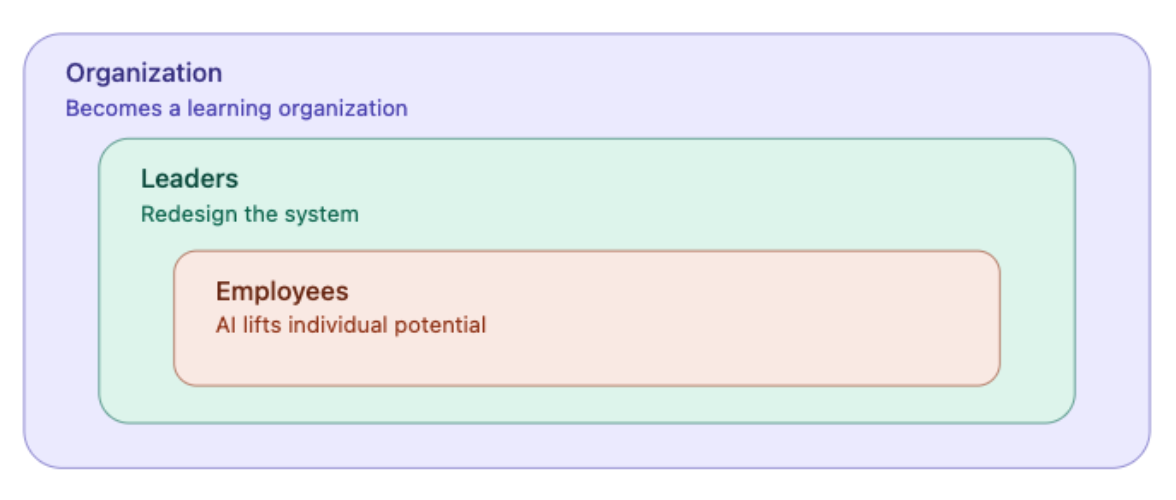
Employees: AI lifts the ceiling on individual potential
AI is widening what we can do, and raising the premium on judgment, clear intent, and the design of work itself.
AI increasingly supports cognitive work, helping people analyze information, solve problems, evaluate options, and think creatively, alongside working with others, finding information, and producing output. Employees at every level now have a partner that helps them analyze, synthesize, and deepen their own expertise while building knowledge in new areas. AI is not only helping us work faster. It is broadening who can take on the most valuable work. Across three controlled studies, generative AI raised business users' performance by about 66% on average, with the biggest gains going to the least-skilled workers, narrowing the gap between top and bottom performers and, in some studies, improving quality. Stanford's AI Index reaches the same conclusion: AI tends to boost productivity and narrow skill gaps across the workforce.³
The shift shows up in how people describe their work: many say AI lets them spend more time on their most valuable work, and that they are producing work they could not have produced a year ago. In the same research, business professionals produced 59% more documents per hour, and programmers completed 126% more projects per week; support agents reached in about two months a level of performance that usually takes eight.⁴ That effect is strongest among power users, the most advanced adopters of AI. These power users deploy agents for workflows that span many steps and build systems that coordinate several agents at once. They routinely rethink how work flows and identify where agents can support or take over tasks, and they help set shared AI standards for their team or organization. They remain a small but disproportionately valuable group.
But as AI expands what people can do, it also raises the premium on sound judgment, and most users recognize this. Asked which human skills matter more as AI takes on more work, they point to quality control of AI output and critical thinking, the ability to analyze information objectively and reach a reasoned judgment. Most say they treat AI output as a starting point rather than a final answer, and that they stay responsible for the thinking. They see their role shifting from producing answers to evaluating, refining, and owning them.
Power users are even more attuned to the value of human judgment when working with AI. They score higher on the measures tied to critical thinking and quality control, and it shows in how they work. Compared with other AI users, they are more likely to deliberately do some work without AI to keep their skills sharp, and to pause before starting in order to decide what should go to AI and what should stay with a person. These power users refuse to outsource their thinking. They know lasting success depends on continuing to build human skills rather than letting them fade.
As AI use matures across the workforce, the most effective users will not be the ones who simply do more, faster. They will be the ones who redefine their value around what only people can do: setting clear intent, meaning defining the outcome they want and the quality bar it must meet, and designing how the work gets done across people and AI. They bring judgment and taste, build trust, and shape systems that produce better results. The question is no longer "Which tasks define my job?" but "Which outcomes am I now positioned to drive?"
Leaders: The job of every leader is to rearchitect work
Most organizations are not yet built to capture the value of this expanded human agency. The challenge is not isolated to tools or individuals. It is a breakdown across the system that connects leadership, culture, management practices, and how work is measured.
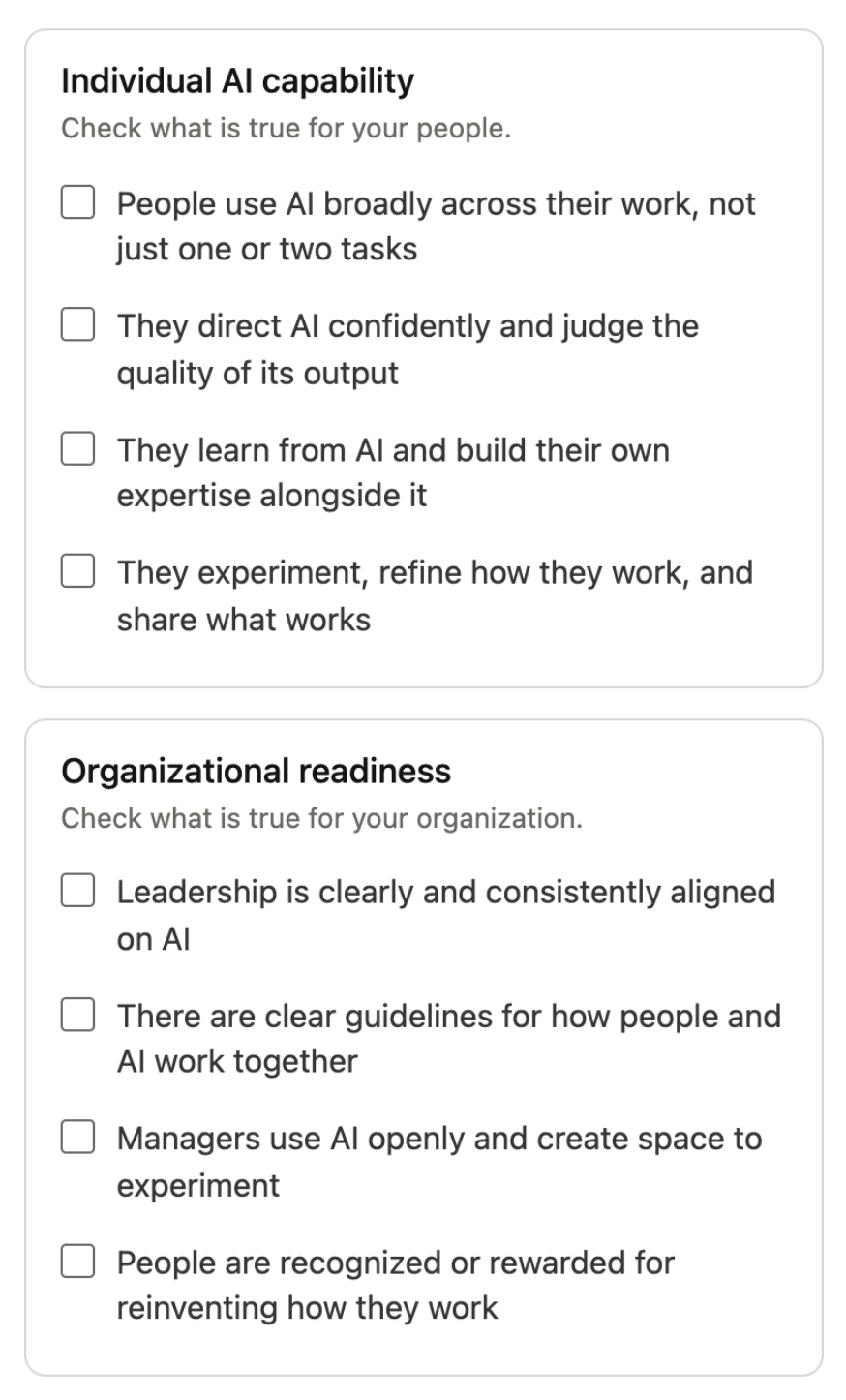
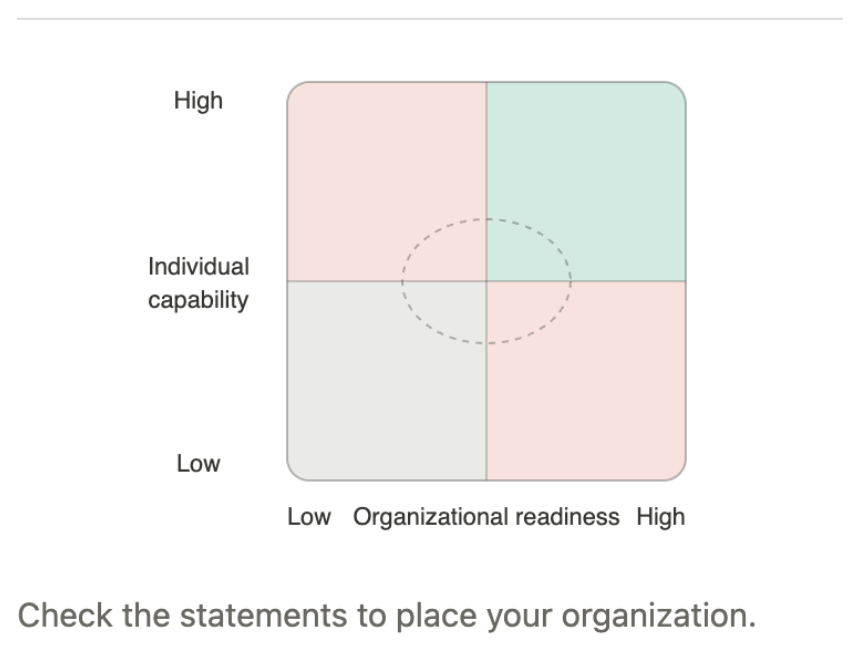
These dynamics play out along two dimensions: an individual's capability with AI and their organization's readiness to absorb it. Individual capability reflects how broadly someone uses AI and how confidently they direct it, judge its output, and learn from it. It also covers how actively they experiment and share what they learn, and whether they create new value with AI, from improving the quality of work and processes to enabling work they could not do before. Organizational readiness reflects the environment around them: culture and management practices that support AI use, clear rules and guidelines for how people and AI work together, and whether AI use is encouraged and recognized.
Set those two dimensions against each other and a few recognizable groups appear, and in many cases employees are moving faster than the organizations around them. A small group sits in the aligned corner, where individual capability and organizational readiness are both high and reinforce each other. At the other end, some are stuck, with low capability and limited organizational support. Many more are misaligned in one of two ways: some have built strong individual skills but lack the systems to apply them, while others sit in ready organizations but have not yet caught up. The largest share sits in the messy middle, where both individual practice and organizational conditions are still taking shape.
This misalignment is reinforced at the top. Relatively few people say their leadership is clearly and consistently aligned on AI, and leaders themselves tend to be more likely than employees to say that reinventing work with AI feels safe and rewarded. What emerges is a pressure point where the pull to perform collides with the push to transform. Many people fear falling behind if they do not adapt quickly with AI, yet many also say it feels safer to focus on current goals than to redesign how they work. And only a small share say they are rewarded for reinventing their work with AI when results fall short.
This is the paradox at the heart of the problem: employees are ready to reinvent how they work, but the system around them, its metrics, incentives, and norms, keeps reinforcing the old way. The same forces accelerating AI adoption are also holding it back.
Leadership must redesign the system to match the work
The job of every leader right now is to make change stick. That means setting strategy at the top and ensuring the metrics, incentives, and expectations reward people for changing the way they work. Once that strategy is set, managers are the ones who put it into practice, and their ability to do so makes a marked difference. The dynamics are intuitive but powerful: when managers actively use AI themselves, employees engage more deeply, think more critically about their own AI use, and trust it more. And when managers create psychological safety around experimentation, employees grow more ready to adopt AI and more likely to use it regularly.
Power users consistently work in this kind of environment. Compared with other AI users, they are far more likely to say their manager openly uses AI, sets quality standards for AI work, creates space for experimentation, and encourages more ambitious redesign of work. They are also much more likely to say they are rewarded for reinventing their work with AI regardless of outcome.
Individual potential compounds when leadership sets direction, culture supports experimentation and learning, and management practices reinforce new ways of working. At its core, this is a systems problem. And systems do not fix themselves. They have to be redesigned.
Organizations: Every firm is a learning organization
The firms pulling ahead focus on absorbing AI, not just adopting it. They redesign how work gets done and turn output into insight, and when that insight is captured, shared, and built into how the organization operates, it becomes a learning organization that reinforces itself.
Many leaders focus on hiring the right people and assume results will follow. The bigger driver is something else: the conditions leaders create for that talent to thrive. When you weigh the factors that shape how much value people get from AI, organizational, individual, and demographic, the organizational factors like culture, manager support, and talent practices matter far more than individual factors like mindset and behavior. By impact, we mean practical outcomes: whether people say AI helps them produce higher quality work, collaborate more effectively, and take on new kinds of work.
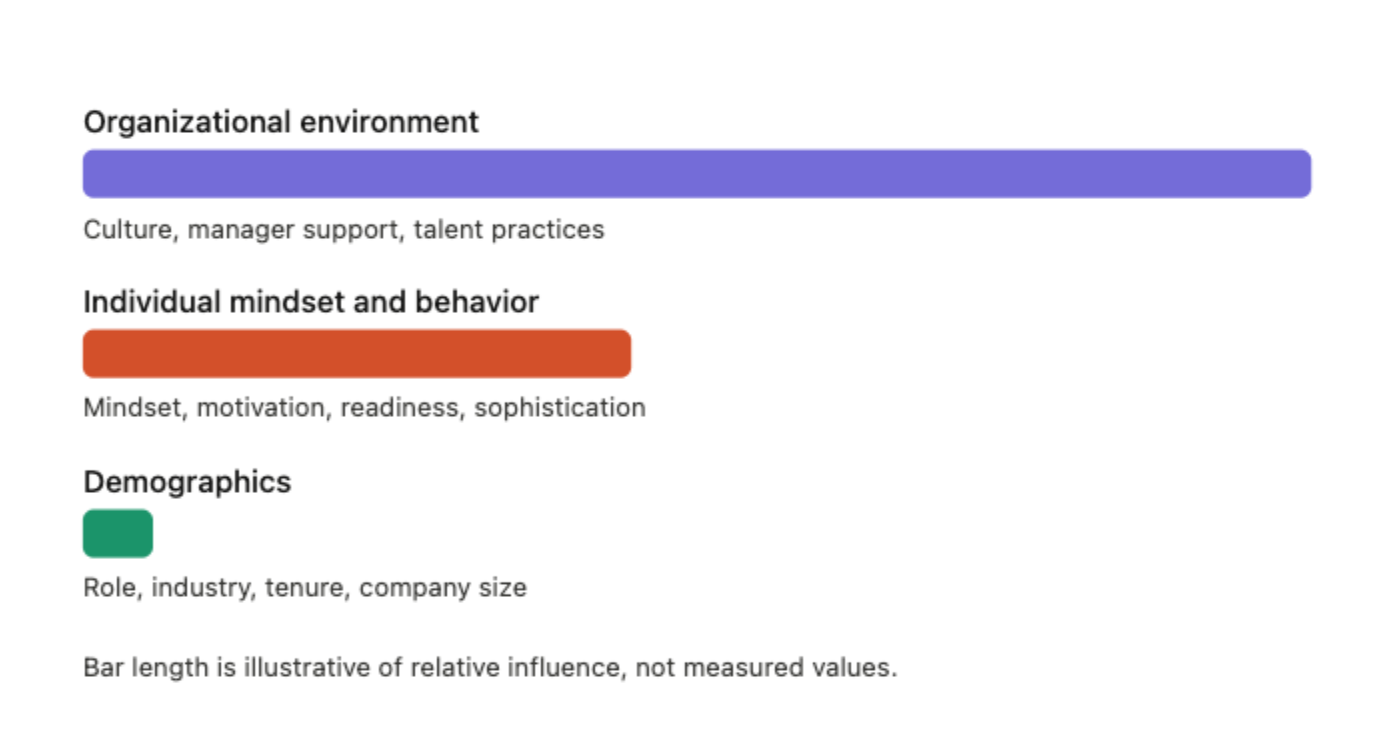
The lesson is the value of an environment that is ready for AI: a culture that treats AI as a strategic advantage and encourages experimentation, managers who model AI use and reward it, and talent practices that build skills and create the space to apply them.
The real question is not whether people have the right skills. It is whether the organization is built to unlock them.
Redesigning systems and processes
The number of active agents at work is climbing fast, and the largest enterprises are scaling them fastest of all. As agents take on more, they also generate valuable signals: what worked, what failed, where outcomes drifted. In many organizations those signals stay local or spread slowly. The firms in front treat them differently. They capture these signals and encode them into shared routines, improving future work while preserving accountability and control.
Power users, for instance, are far more likely than other AI users to say their teams brainstorm and refine business processes together to spot AI opportunities, to share tips, new agents, lessons, and mistakes, and to discuss quality standards for work done with AI. They are also more likely to report that agent workflows, human handoffs, and quality standards are documented and repeatable at the team, function, and organization level.
Building an evaluation infrastructure
Creating those systems takes a disciplined approach to holding people accountable for the work that agents execute. Functions that deploy agents at scale tend to see the same pattern: the more agents execute, the higher the stakes around human review. Approving one weak output is manageable, but when weak outputs slip through at scale, the risk compounds, and the stakes are rising: reported AI incidents jumped 56.4% to a record 233 in 2024.⁵ The answer is an evaluation infrastructure that can keep pace with agents, and it starts with three questions every organization will need to answer: Who reviews agent performance? Who has the authority to update the workflows agents run? And how does a local win get captured and scaled across the organization?
Organizations that can answer these questions build institutional knowledge that compounds over time, is unique to the firm, and hard for others to replicate.
Building that infrastructure also takes coordinated reinvention across four roles: employees, who rearchitect their work around intent and review; leaders, who redesign processes around outcomes and agent autonomy; IT, which builds the infrastructure for running agents at scale; and security, which ensures trust is woven into the system itself.
For IT leaders, that means treating agents as managed entities with identities, permissions, policy enforcement, and lifecycle management. IT becomes the control plane for agent operations, extending the same rigor already applied to people and applications so that scale does not come at the cost of visibility. For security leaders, it means accounting for the new risks agents introduce: data exfiltration, unintended system actions, and unauthorized access. Securing agents means embedding monitoring, policy enforcement, and auditability directly into the platform, so that trust operates as a structural property of the system.
When these four roles work in concert, the organization becomes a true learning organization: one where work continuously produces insight, and insight continuously reshapes how work gets done.
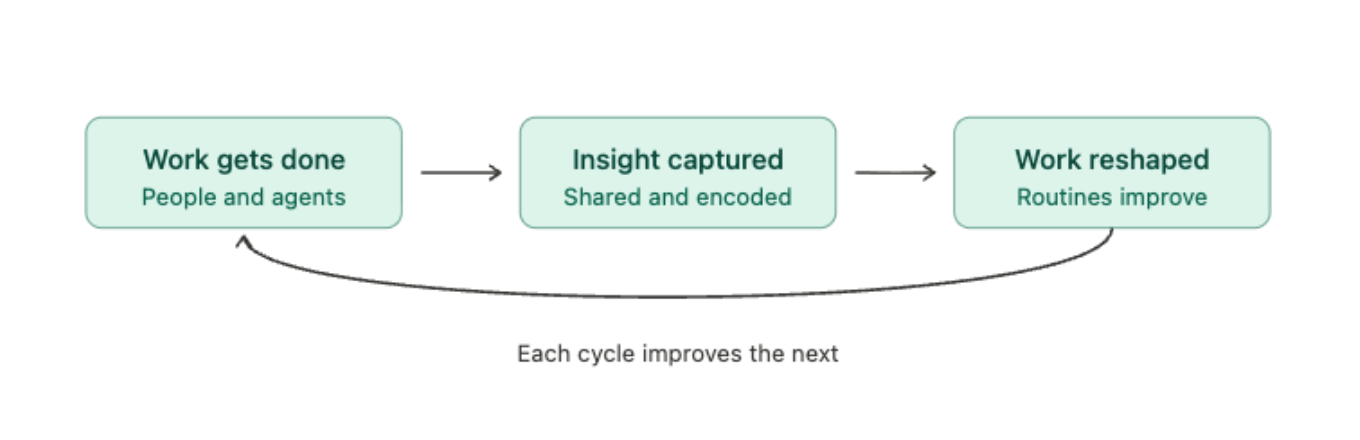
The organizations pulling ahead build institutional knowledge that compounds over time, is unique to the firm, and hard for others to replicate.
Looking ahead
The firms that build a new operating model today will not just move faster in the short term. They will build something more durable, setting themselves up to create value in ways we cannot yet imagine: an organization that learns faster than its competitors, compounds its own intelligence, and gets harder to catch with every cycle.
This shift will not happen easily. Some jobs will change. Some will go away. And many that do not exist yet will emerge. In just the past few years, employers have created large numbers of new roles tied to AI, such as data annotators and AI engineers, that did not exist before and have quickly become essential to the digital economy. This kind of dynamism is not new to work, but its pace and scale are, and the uncertainty people feel is real. What is also real is that the potential for people to make an impact has never been higher.
Leaders are starting to redesign the systems around them. The organizations that capture what their work is teaching them are learning faster than the ones that are not. None of that happens by accident. The opportunity in front of every leader and every organization is to take control: to build a place where agents amplify what people can do, where human judgment stays at the center of the work that matters, and where we all have the agency to decide what comes next. This is what AI can mean for all of us, if we choose to do the work to get there.
Sources
Stanford HAI, 2026 AI Index Report (2026), https://hai.stanford.edu/ai-index/2026-ai-index-report; Stanford HAI, 2025 AI Index Report (2025), https://hai.stanford.edu/ai-index/2025-ai-index-report
Stanford HAI, 2026 AI Index Report (2026), https://hai.stanford.edu/ai-index/2026-ai-index-report
Nielsen Norman Group, "AI Improves Employee Productivity by 66%" (2023), https://www.nngroup.com/articles/ai-tools-productivity-gains/; Stanford HAI, 2025 AI Index Report (2025), https://hai.stanford.edu/ai-index/2025-ai-index-report
Nielsen Norman Group, "AI Improves Employee Productivity by 66%" (2023), https://www.nngroup.com/articles/ai-tools-productivity-gains/; Nielsen Norman Group, "AI Tools Raise the Productivity of Customer-Support Agents" (2023), https://www.nngroup.com/articles/ai-productivity-customer-support/
Stanford HAI, 2025 AI Index Report (2025), https://hai.stanford.edu/ai-index/2025-ai-index-report